http://dx.doi.org/10.35381/e.k.v5i9.1662
The use of gammification in the english language classroom to increase vocabulary in beginners (a1 level)
El uso de gamificación en el aula de inglés para aumentar el vocabulario en principiantes (nivel a1)
Clara Lucia León-Flores
clara.leon.37@est.ucacue.edu.ec
Universidad Católica de Cuenca, Cuenca, Cuenca
Ecuador
https://orcid.org/0000-0003-4900-2245
Melita Vanessa Vega-Auquilla
Universidad Católica de Cuenca, Cuenca, Cuenca
Ecuador
https://orcid.org/0000-0002-6501-4011
Recibido: 15 de septiembre 2021
Revisado: 10 de noviembre 2021
Aprobado: 15 de diciembre 2021
Publicado: 01 de enero 2022
ABSTRACT
The present mixed methods study examined the effect of gamification on vocabulary acquisition of software development students enrolled in an A1 English language course at a higher education institute in Cuenca, Ecuador. Study participants were divided into an experimental and control group, with the former receiving instruction through various digital platforms, while the latter were taught through traditional classroom methodologies. After two weeks of instruction, a statistically significant increase was observed in the experimental group's mean vocabulary test scores. It was concluded that student’s vocabulary acquisition and motivation were more positively impacted by gamification than traditional classroom methodologies, thus leading to the conclusion that gamification is an effective and dynamic tool for use in the English language classroom. Recommendations and a sample lesson plan are included.
Descriptors: Educational games; simulation games; team teaching. (UNESCO Thesaurus).
RESUMEN
El presente estudio de métodos mixtos examinó el efecto de la gamificación en la adquisición de vocabulario de estudiantes de Desarrollo de Software matriculados en un curso de inglés A1 en un Instituto de Educación Superior en Cuenca, Ecuador. Los participantes fueron divididos en un grupo experimentales y de control; los primeros recibieron instrucción mediante varias plataformas digitales, mientras que los últimos fueron expuestos a metodologías tradicionales. Luego de dos semanas, se observó un aumento estadísticamente significativo en el vocabulario del grupo experimental. Se concluyó que la gamificación tuvo un impacto más positivo en la adquisición de vocabulario y la motivación de los estudiantes que las metodologías tradicionales. Se concluyó que la gamificación es una herramienta efectiva y dinámica para la clase de inglés. Se incluyen recomendaciones y un plan de enseñanza.
Descriptores: Educational games; simulation games; team teaching. (Tesauro UNESCO).
INTRODUCTION
Gamification in teaching is a feasible educational approach that fuses educational technology with the mechanics and dynamics of game using techniques in a competitive environment based on digital games, assigning points, obtaining rewards and feedback, and creating motivating learning experiences, whose purpose is to reach a goal through the resolution of a problem. Gamification has been shown to not only increase motivation, but also foster students’ commitment to learning. Motivation includes factors such as emotion, surprise and experimentation, which can also be considered basic ingredients for acquiring vocabulary knowledge. In this way, learning emerges between the interaction of emotion and cognition and play constitutes teaching disguised as a powerful tool to promote curiosity, attention, and learning (Kapp, 2012).
Research indicates that gamification is made up of interactive elements such as missions, challenges, levels, and rewards that involve students in the game. The teacher uses these elements to design a curriculum, which includes learning objectives, selected vocabulary and the creation of activities transformed into search challenges (Kingsley & Hagen, 2018). Certainly, gamification is a tool composed of similar elements in planning such as objectives and activities that include rules, standards of behavior as well as goals to be achieved, among the advantages that are promoted include increased motivation and improve attention, generation of states of well-being of the students and active breaks avoiding fatigue, as well as increased in student development (Maja Veljkovic, 2017).
However, despite its perceived benefits, some critics assert that gamification does not help teach anything meaningful, and instead serves as a distraction due to elements such as frustration of students who expect to have the same type of answers and do not find them. Also, the evaluation of the student may not be easy, as it can be a time-consuming process that requires prior planning and logistical set up of platforms (Furdu et al. 2017).
While the introduction of gamification is causing a great impact on education, research on the use of different platforms to increase vocabulary and motivation is still in a growing phase, particularly in Latin America. Therefore, the aim of the present study was to examine the effect of gamification through different platforms on the vocabulary skills and motivation of A1 English learners at a high school in Ecuador.
1. What is the relationship between the gamification and motivation in A1 English language learners?
2. What is the impact of using gamification on the vocabulary in A1 English language learners?
THEORETICAL FRAMEWORK
Key foundations for gamification can be found in theories on motivation and constructivism, where social psychology theory clearly defines the role of attitudes and motivation. Motivation is an important factor in the academic achievement of students as it affects the attitude that drives them to achieve a goal. The motivation of students depends first on their aspirations to learn a language, second on their objectives to learn and third, on the challenge that they are ready to initiate (Gardner et al. 1985). For instance, gamified teaching has been shown to foster affective factors through activities based on obtaining scores, badges and challenges that lead students to interact with each other and support each other because they motivate them to learn.
Sociocultural theory emerged with the purpose of highlighting social interrelationships, which are applicable to school practice. Its contributions have led to rethinking the role of the educator in the classroom; that is, the role of the teacher will be to offer a more humane education that encourages dialogue and participation with the aim of forming creative, active, critical people. The teacher must develop meaningful activities that include challenges that trigger communication, self-reflection and cooperation. To do this, the teacher must make use of motivating strategies that trigger effort, understanding, social interaction and affective support as driving forces in the students (Chaves-Salas, 2001).
The concept of the Zone of Proximal Development, Cognitive Development and constructing new understanding through problem solving and critical thinking can also be linked to gamification. The concept of self-regulation is a response to power relationships and affective factors. Simultaneously, language is a tool to mediate these factors. Social interaction is an indispensable condition for scaffolding which support the ZPD (Al-Smadi, 2015).
The attitude concept which has cognitive, affective, and conative components. Also, motivation concept, because if the students are motivated to learn language, they will. The achievement concept has been viewed in terms of knowledge about the structure of the language such as vocabulary, grammar, pronunciation, or in terms of proficiency in the four skills, speaking, understanding, reading and writing. has revealed that the important components to achieve motivation are effort, want and affect. Since every objective implies an effort, then it can be understood that learners can be motivated with a positive attitude based on the desire to achieve success; when the objective meets the effort, motivation emerges. In the language classroom, students need to be motivated to learn in order to succeed (Gardner et al. 1985).
Critics have questioned language proficiency sand assessing classroom achievement. (Oller, 1980), for example, has argued that all tests involve complex language material, therefore to obtain positive results, the teacher must look for adequate methods so that the reinforcement evaluation will be useful and meaningful for the students. Similarly, (Hulstijn, 2011), has discussed the existence of the language ability components linked with language skills. Additionally, it has been argued that the relationship between attitudes and motivation is important to second language achievement (Gardner et al. 1985). This means that motivated students with positive attitudes towards a second language will be willing to acquire knowledge easily than those who are unmotivated and with a negative attitude.
Constructivism research proposed a new teaching-learning paradigm that positions the teacher as a facilitator of knowledge and the student as the protagonist responsible for their own learning. In this paradigm, a number of essential principles materialize: since learning is active, the student must act; learning requires language since it influences it as language and learning interact; learning is a social activity that is associated with teachers, family, and friends and where motivation is essential; and, evaluation is part of the process, as it is an end (Sharma, 2014).
Early manifestations of gamification include WebQuest, a platform developed by Dodge and March in 1995 that aimed to solve problems through the use of internet resources (Yang, 2014). This system was related to one of the principles of constructivism where learning is supposed to begin in the students' environment. One of its fundamental characteristics was motivation as a key element for learning since texts were no longer used, but, rather, the web where the student could access a database with updated information. An important characteristic was that students worked in a team, with everyone destined to take responsibility and develop their knowledge about an objective and point of view of a project. Finally, the evaluation accompanies the final product and is carried out by the students, the teacher and a combination of them being an important part of this process (McMahon, 2011).
The Kahoot platform
In reviewing research on building vocabulary skills and classroom engagement, the Kahoot platform has been proven to be of great support to many teachers seeking a methodology that is not only interactive but also motivates students to achieve proposed objectives through the use of multiple activities including as worksheets, cards, questions, surveys and questionnaires. The role of the teacher is to be the host and the student the contestant, and the student acquires and improves language skills based on a competition system where increasing the knowledge of vocabulary will allow them to conquer the podium (Debbita-Tan-Ai-Lin & Kaur, 2018).
The use of Kahoot as a teaching tool in the foreign language classroom has been documented in several studies with experimental and control groups to examine the impact on vocabulary skills. In one study carried out at a University in South Korea in 2018, a high expectation of increase the vocabulary of students and teachers was generated due to the effectiveness of the Kahoot application for learning a foreign language. The study was carried out through a quasi-experimental method using surveys and cooperative methodologies for experimental and control groups. Results showed an increase in vocabulary in the experimental group, which showed that Kahoot had helped improve vocabulary skills while fostering a positive learning environment and a meaningful learning experience (Reynolds & Taylor, 2020).
Another study found that teaching using Kahoot was more effective than using conventional methods for the purposes of vocabulary acquisition, as seen after a quasi-experimental study with an experimental group that exposed to the use of the Kahoot platform and a control group that received traditional teaching. The differences in vocabulary results were significant (Merve et al. 2021).
Perceptions among learners on digital games
Teachers’ perspectives on gamification
Research shows the perspectives of teachers have changed nowadays. In the past, the objective of education was to teach an objective set based on the curriculum; today in modern times, education has rethought its objectives and now seeks to develop competencies in students so they can make use of their creativity, innovative technologies, and invent new solutions to problems presented. For this reason, education faces a challenge in that its professionals must develop efficient digital strategies to create an interactive environment for students that is different from the traditional classroom. As a consequence, the role of the school will be to transform its teaching through innovative processes and the role of the teacher in the face of this new challenge will be to interact with these learning environments as a facilitator of processes, a trainer of new digital systems and a constant evaluator of their creations (Schleicher, 2016).
In a study carried out on 3,183 Ecuadorian teachers of different educational levels through an online questionnaire titled Effects of the Covid-19 pandemic in the National Educational System of Ecuador, in 2021 it was found that despite the fact that they stated that they had agreed with the government to telecommute, there were many limitations that prevented them from having learning successes. Among these limitations were the lack of technological resources and internet in institutions that served as barriers to teaching. Also, teachers' lack of confidence in the effectiveness of online classes was also a factor. While 40% of teachers considered online education relevant, 60% believed it is not as effective as face-to-face education; this may be the result of a lack of knowledge of online teaching methods. Some teachers need more professional development because they are lack of knowledge, lack of proficiency with technology (Andrade-Vargas et al. 2021).
Studies about teacher training
Research has demonstrated that the professionalization of teachers in countries such as Colombia is the product of the efforts of organized teachers who have promoted recognition of their activities and contribution to success. Strengthening has occurred through institutes, universities and teacher training schools known as normal schools. This has occurred through teacher training since the beginning of the 20th century, which has resulted in a close relationship between professional practice and academic, work and salary conditions, where the quality of education in general is reflected and where the role of the teacher is important. Among the changes that the system has presented are undergraduate programs, the strengthening of research training in proposals dedicated to teacher training, and the mandatory accreditation of high quality. In this way, the achievement of improvements in education as well as the training process of its teachers has become a reality (Cano & Ordoñez, 2021).
The affective filter theory
One of the theories proposed by Steven Krashen is the affective filter, which demonstrates how affective factors influence the acquisition of a second language. In this way, when a student experiences negative emotion during learning, these emotions will block the entry of learning. On the other hand, if students get positive emotions, the affective filter will be reduced. This theory supports that the emotional factors that affect students are motivation, self-confidence and anxiety. Therefore, if a student experiences high motivation, high confidence and low anxiety, the acquisition of knowledge will be consolidated in the brain and as a consequence the students will have learned (Cuicui, 2020).
Research design
The present study used a mixed-methods approach to examine the impact of gamification on vocabulary acquisition and motivation. The quantitative phase involved a pre- and post-test created in Kahoot to evaluate the vocabulary skills of two groups of students at a beginner A1, who were divided into control and experimental groups, with the latter receiving exposure to gamification. The qualitative phase included an online survey to understand the perceptions of the study participants on gamification and motivation to be able to draw comparisons to conventional learning.
Participants
The participants for the experimental group were a sample of 20 students from the Juan Bautista Vazquez Higher Education Institute, from the first semester of Software Development, whose ages ranged between 18 to 20 years old and who had an A1 level of English. The participants the control group were nine students from the same school, who were also from the first semester of Software Development with similar age ranges and levels of English. Both groups were taught by the same teacher, who used similar tools to collect data (see Table 1).
Table 1.
Control and experimental groups.
|
Control group (traditional learning) |
Experimental group (exposed to gamification) |
|
A1 |
A1 |
|
Pre-questionnaire (8) |
Pre-questionnaire (19) |
|
Pre-vocabulary test (12) |
Pre-vocabulary test (21) |
|
Traditional learning |
Gamified learning |
|
Post-vocabulary test |
Post-vocabulary test |
|
|
Post-questionnaire |
Procedure
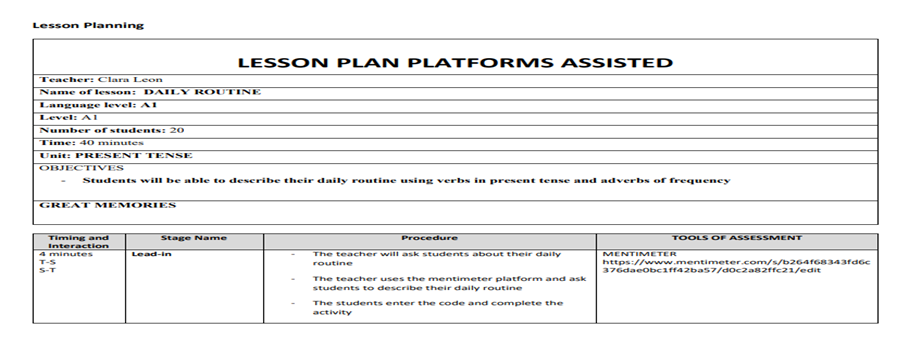
Notification and negotiation with the authorities of the institution was secured through a signed letter of commitment that guaranteed confidentiality of all data collected. The 29 study participants were divided into two groups and enrolled in two separate online classes, Group A, which was designated as the experimental group, and Group B, which served as a control group. Over the course of the intervention, which lasted two weeks with 16 hours of instruction per week, Group A received gamified instruction via online classes while Group B received traditional instruction via online classes. The only difference between the two classes was the presence of gamification elements in one group. Both classes were designed by the same teacher using the same curricular planning, which was vocabulary related to daily routines, verbs in present tense and the use of aids for two weeks.
Prior to the start of the experimentation period, a didactic guide was given to all students, which contained goals, contents to be learned as vocabulary related to daily routines, verbs, and grammatical structures (affirmative, negative and interrogative sentences). They were made aware of the platforms to be used (Mentimeter, vocaro.com, Padlet, Kahoot, Moodle, You to be) and the types of resources and grading criteria including worksheets, record of attendance and rubrics.
Both groups completed a pre-test to measure their vocabulary skills before the start of the experiment as well as a post-test afterward to measure any differences in achievement. Both tests featured 10 questions multiple choice questions related to the vocabulary terms learned in class. Both the control group and the experimental group completed a pre-questionnaire asking their perceptions regarding English language education in general. Only the experimental group completed a post-questionnaire to evaluate their motivation to learn after being exposed to gamification, as well as their opinions as to how motivated they felt with traditional learning.
DATA ANALYSIS
Quantitative results
The results of the vocabulary test scores for both groups were processed through the SPSS software program to calculate mean scores and verify significance. The first output for the experimental group’s test scores can ben seen in Table 2, which shows a numerical difference of 2.5 between the pre and the post test.
Table 2.
Descriptive statistics for pre and post test scores - Experimental group.
|
Descriptive Statistics |
|||||||||
|
|
N |
Mean |
Std. Deviation |
Minimum |
Maximum |
Percentiles |
|
||
|
25th |
50th (Median) |
75th |
|
||||||
|
PreTest_EXP |
20 |
6.00 |
1.522 |
4 |
10 |
5.00 |
6.00 |
6.75 |
|
|
PostTest_EXP |
20 |
8.50 |
2.212 |
3 |
10 |
6.50 |
10.00 |
10.00 |
|
The second output (see Table 3) shows the first calculation of the Wilcoxon Signed Ranks Test, a non-parametric test of statistical significance appropriate for related data samples of non-normal data such as test scores from the same group of students who have been tested at two different periods of time. The ranks show that 80% of the tests increased in their numerical score.
Table 3.
Ranks test for experimental group vocabulary test scores.
|
Ranks |
||||
|
|
N |
Mean Rank |
Sum of Ranks |
|
|
PostTest_EXP - PreTest_EXP |
Negative Ranks |
2a |
5.50 |
11.00 |
|
Positive Ranks |
16b |
10.00 |
160.00 |
|
|
Ties |
2c |
|
|
|
|
Total |
20 |
|
|
|
|
a. PostTest_EXP < PreTest_EXP |
||||
|
b. PostTest_EXP > PreTest_EXP |
||||
|
c. PostTest_EXP = PreTest_EXP |
||||
To determine whether the apparent increase was significant, a final hypothesis test was conducted. The null hypothesis established was that there would be no difference between the mean vocabulary test scores. The level of significance, also known as a critical value, was established at 0.05, or a 95% confidence rate. In addition, a p value approach to hypothesis testing was also applied to measure the probability that the numerical difference between two sets of vocabulary scores could have been due to chance. When testing hypotheses, the smaller the p value (close to zero), the higher the probability that a null hypothesis will be contradicted (Doane, 2016). Table 4 shows the results of the test which shows an asymptotic significance or p value of less than 0.05, which means the null hypothesis must be rejected. This indicates that the numerical increase in the mean vocabulary test scores among the experimental group was statistically significant after the intervention (Z= -3.265b, *p=.001).
Table 4.
Wilcoxon Signed Ranks Test result for experimental group test scores.
|
Test Statisticsa |
||
|
|
PostTest_EXP - PreTest_EXP |
|
|
Z |
-3.265b |
|
|
Asymp.Sig. (2-tailed) |
.001 |
|
|
a. Wilcoxon Signed Ranks Test |
||
|
b. Based on negative ranks. |
||
Differences between the test scores of the experimental and control groups were also analyzed and processed through the SPSS software to calculate mean scores, test for significance and draw comparisons. The first output for the experimental group’s test scores can be seen in Table 5, which shows a numerical difference of 2.44 between the pre and the post test.
Table 5.
Descriptive statistics for pre and post test scores – Control group.
|
Descriptive Statistics |
||||||||
|
|
N |
Mean |
Std. Deviation |
Minimum |
Maximum |
Percentiles |
||
|
25th |
50th (Median) |
75th |
||||||
|
PreTest_CON |
9 |
4.00 |
3.122 |
0 |
10 |
1.00 |
4.00 |
5.50 |
|
PostTest_CON |
9 |
6.44 |
1.810 |
4 |
9 |
4.50 |
7.00 |
8.00 |
The second output (see Table 5) shows the first calculation of the Wilcoxon Signed Ranks Test, which shows that 77.77% of the tests increased in their numerical score while 22.22% decreased.
Table 6.
Ranks test for control group vocabulary test scores.
|
Ranks |
||||
|
|
N |
Mean Rank |
Sum of Ranks |
|
|
PostTest_CON - PreTest_CON |
Negative Ranks |
2a |
4.25 |
8.50 |
|
Positive Ranks |
7b |
5.21 |
36.50 |
|
|
Ties |
0c |
|
|
|
|
Total |
9 |
|
|
|
|
a. PostTest_CON < PreTest_CON |
||||
|
b. PostTest_CON > PreTest_CON |
||||
|
c. PostTest_CON = PreTest_CON |
||||
A final hypothesis test was conducted to assess whether the differences were significant, which showed p value of more than 0.05 (see Table 6). This indicates that the numerical increase in the mean vocabulary test scores of the control group was not statistically significant (Z= -1.667b, *p=.095). In other words, the experimental group experienced greater vocabulary gains than the control group.
Table 7.
Wilcoxon Signed Ranks Test result for experimental group test scores.
|
Test Statisticsa |
|
|
|
PostTest_CON - PreTest_CON |
|
Z |
-1.667b |
|
Asymp. Sig. (2-tailed) |
.095 |
|
a. Wilcoxon Signed Ranks Test |
|
|
b. Based on negative ranks. |
|
Qualitative results
Qualitative data were collected from the experimental group through the use of the Padlet platform. The benefit of this interactive online educative tool was that it invited the participants to share their opinions with security and tranquility. They responded freely and honestly, which helped with the interpretation of the data. The instructions were to answer questions about what they thought of the intervention, whether they felt their vocabulary had increased, and their perceptions on the tools used. The data were recorded on a bulletin and transcribed using the variety of perspectives expressed by the participants.
Among the responses from the participants, the most common phrase that emerged was "It was very dynamic and entertaining." This view was echoed by another participant who said "I think it has helped me a lot since the stress in classes has been reduced with the dynamics." The majority of participants agreed that the experimentation was educative and incredible. For example, one interviewee said that he felt like it was a good way to learn English. Many interviewers believed that it was a good way of teach and learn.
When the participants were asked about what they thought about the tools, they were unanimous in the view that the tools motivated them to learn more. Some participants stated that the tools were useful and interesting while another described them as “new and creative.” In one case, a participant thought that it [gamification] was a worthwhile way to learn. One participant commented that the tools helped maintain their attention in class.
In response to the question if they thought their vocabulary had increased, most responded they felt their skills were reinforced. The majority of participants agreed that since the classes were more participatory and dynamic (non traditional), they were more active and that vocabulary learning was increased. The control group stated that the English classes are learned by necessity and did not show the motivation that the experimental group demonstrated for the English classes.
DISCUSSION
Once the qualitative and quantitative data were obtained, the difference of the averages of the experimental group in relation to the averages of the control group could be observed. The experimental group showed a statistically significant increase in vocabulary; while the control group also showed a slight increase in vocabulary, it was not statistically significant, which may have been the result of the smaller sample size of the control group. Nevertheless, the results reflect a positive effect of gamification on students’ vocabulary.
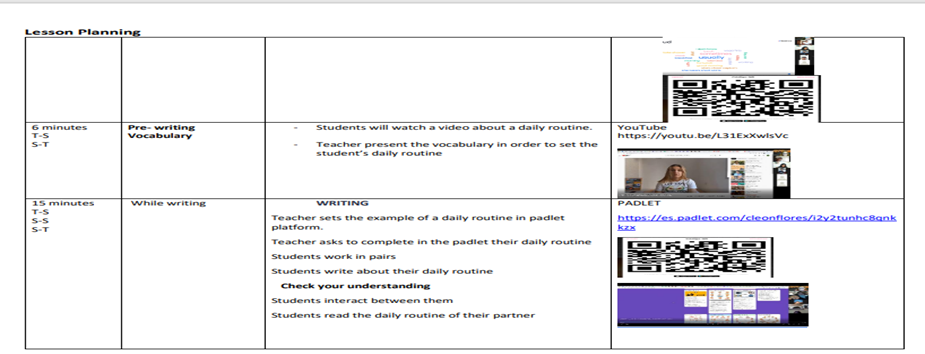
In the introduction of each class with the use of Mentimeter and YouTube platforms, much student participation was observed. In comparison with the control group, where introductions and techniques were made in class in a traditional way, it could be seen that gamified learning not only attracts attention, but also motivates students to learn. While they felt confused at the beginning, they later reported they found it engaging, dynamic and attractive.
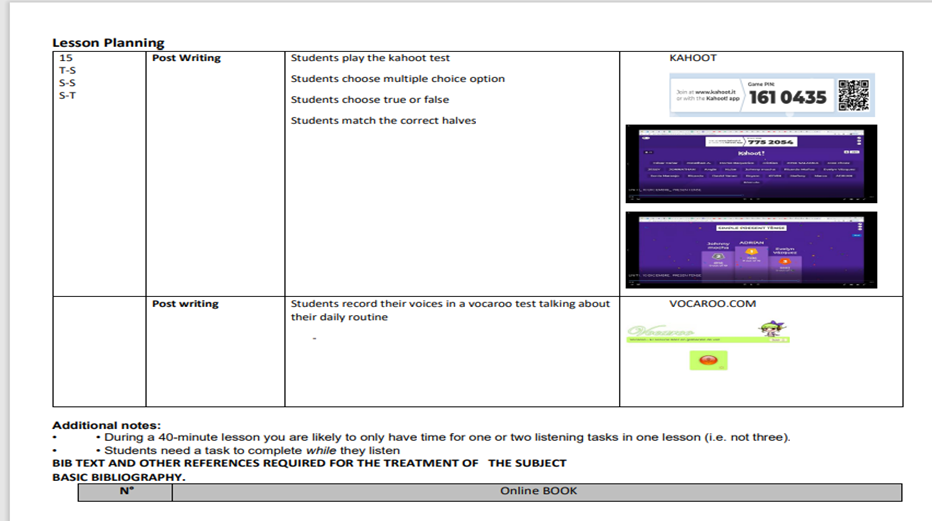
The acquisition of grammar was also positively affected with the combination of platforms such as YouTube and Kahoot, whose objective was to relate adverbs of frequency with verbs of daily routines. The video of the daily routine was shared from YouTube, and the students made their own sentences relating the information they saw with their information. For vocabulary consolidation, the Kahoot platform was used, which contained multiple choice, true false and matching questions. This platform was very interactive in that it allowed students to be finalists, winners or to be awarded based on a point system. This reward system based on the achievements obtained by the acquisition of vocabulary kept them very attentive and willing to be better every day. Not only were they looking to win the points, but also to learn more vocabulary. It could be observed that this incentive process motivates learners to be more effective and creates a feeling of happiness in personal achievements.
As for the reinforcement of listening and speaking skills, the Vocaroo platform was used in a class lesson where the students, after listening and reviewing their answers, were asked to practice correct pronunciation and record an audio and send the link to a WhatsApp group where their recordings were graded with a rubric. They liked this gamification system of productive experiences shared with all the students because it afforded them the opportunity to improve through practice and, with better results, obtain a better score.
The Padlet platform was used to demonstrate the learning of the simple present tense based on sentences about the daily routine. For this purpose, a link to the Padlet was sent, where the instructions to complete the information were included, and a photograph of the activities performed had to be attached. Thanks to the application, the participants' enthusiasm and confidence increased, because for most of the students it was easier to write their point of view without being identified than to speak and identify themselves. Given the well documented concerns about anxiety when practicing oral skills (Liu, 2018), it can be concluded that affording anonymity to students can help mitigate concerns about oral performance in online activities. Anonymity also reduces pressure among fellow classmates, which can help students’ learning experiences and increase their willingness to participate in class (Chen, 2019).
Additional effectiveness of gamification that could be observed was on students’ motivation when using the platforms. Once the students were instructed, they were predisposed to interact with the learning environments in the different activities. The interaction sparked their creativity and innovation in the use of digital systems, thus turning them into designers and evaluators of their own creations. Since every objective in class implied an effort, it can be understood that learners can be motivated based on the desire to achieve success; when the objective meets the effort, greater motivation emerges (Gardner, 2008).
From the teacher’s perspective, the use of gamification transformed her role as a teacher, going from teaching to facilitating a process where she could realize that the 40 minutes that a class session has can be turned into an opportunity for the students to realize that if one day was a successful class, the following day’s class would be better. The teacher did not find difficulties in incorporating gamification into a class plan; on the contrary, she was able to create constructivist and interactive processes that dynamized the moments of each class hour, which ranged from the anticipation of knowledge, knowledge construction, consolidation, feedback, and so on. as well as the formative and summative evaluation, which meant a permanent activation of the teaching-learning process. These experiences pointed to the conclusion that with the proper use of gamification led by a trained teacher, it is possible not only to motivate students but also to significantly increase their vocabulary.
The study participants recommended that gamification should be used not only in the English language classroom, but in all subjects as a means of making classes more dynamic and interactive. While measuring the stress and anxiety levels of students was not an objective of this study, participant’s testimonies revealed that the use of gamification helped reduced their stress levels, thus allowing them to feel more motivated to learn in an easier and more entertaining way. In other words, if students get positive emotions, the affective filter will be reduced. Moreover, if a student experiences high motivation, high confidence and low anxiety, the acquisition of knowledge will be consolidated in the brain and as a consequence the students will have learned (Cuicui, 2020).
LIMITATIONS AND RECOMMENDATIONS
One of the great limitations of the intervention was time. At just over two weeks in duration, the intervention yielded a positive response among students, but left an appetite for further instruction. Future studies could extend the intervention time to use new platforms and topics to examine the effect of usage time on other language skills such as speaking and writing.
It is recommended that gamification should be used in schools as a way to increase vocabulary and also to motivate students. The introduction of gamification with its platforms will provide the opportunity for students to be competent in the English language while increasing the knowledge of a lot of vocabulary, exercising their knowledge in pronunciation, obtaining automatic fluency and the development of skills such as productive and receptive speaking, the same ones that cannot be as effective in a traditional classroom.
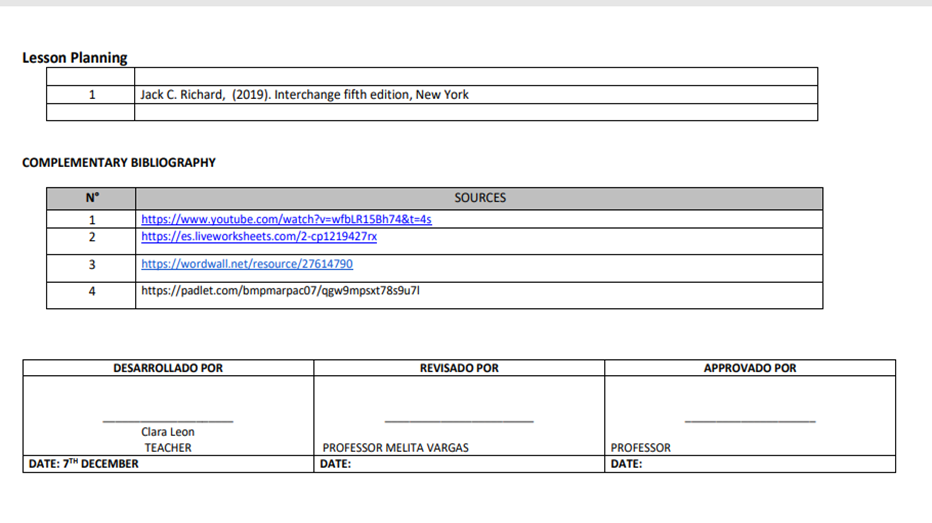
Teachers must give teaching the most important ingredient, the passion to motivate students. When they feel that they love what they do, it is possible to go beyond the needs of the students, which is to look for what they do not have but that is the most important thing that the students lack, motivation. When teachers feel the passion to teach, they search, investigate and find. Gamification is a tool that not only makes classes dynamic, but also motivates students to learn vocabulary with the use of platforms, and also inspire passion among teachers. A sample lesson plan is included in Appendix A.
Non-monetary.
THANKS
To the Universidad Católica de Cuenca for promoting the development of research.
Al-Smadi, M. (2015). GAMEDUCATION:Using Gamification Techniques to Engage Learners in Online Learning. Immersive Education, 486, 85-97. doi:10.1007/978-3-319-22017-8_8
Andrade-Vargas, L., Estevao-Romeiro, A. I., Riofrio-Leiva, V., & Deisi, Y. G. (2021). Teacher's perceptions, institutional chanllenges, and educational sustainability during Covid 19 In Ecuador. Heliyon, 7(12), 10. doi:org/10.1016/j.heliyon.2021.e08596
Cano, M. C., & Ordoñez, E. J. (2021). Formación del Profesorado en Latinoamérica [Teacher Training in Latin America]. Teacher Training in Latinoamerica, 27(2), 284-295.
Chaves-Salas, A. L. (2001). Implicaciones Educativas de la Teoria Sociocultural de Vigotsky [Educational Implications of Vigotsky's Sociocultural Theory]. Revista Educacion, 25(2), 59-65. Retrieved from http://www.redalyc.org/articulo.oa?id=44025206
Chen, C. (2019). Using Anonymity in Online Interactive EFL Learning: International Students’ Perceptions and Practices. International Journal of Education and Development using ICT (IJEDICT), 15(1), 204-218.
Cuicui, C. (2020). The Application of Affective Filter Hypothesis Theory in English Grammar Teaching. Journal of Contemporary Educational Research, 4(6), 4. doi:10.26689/jcer.v4i6.1294
Debbita-Tan-Ai-Lin, D., Ganapathy, M., & Kaur, M. (2018). Kahoot! it: Gamification in Higher Education. Pertanika Journal of Social Sciences, 26(1), 1-18.
Doane, D. P. (2016). Applied Statistics in Business & Economics (5 ed.). New York: McGraw Hill.
Furdu, l., Tomozei, C., & Kose, U. (2017). Pros and Cons Gamification and gaming in classroom. Computers and Society, 8(2), 56-62. doi:arXiv:1708.09337v1
Gardner, E. B. (2008). Attitudinal and Academic Effects of Service-Learning. Journal of Preventionand Intervention in the Community, 18(1-2), 97-109. doi:10.26689/jcer.v4i6.1294
Gardner, R., Lalonde, R. N., & Moorcroft, R. (1985). The role of attitudes and motivation in Second Language Learning: Correlational and experimental considerations. 35(2), 207-227. doi:https://doi.org/10.1111/j.1467-1770.1985.tb01025.x
Hulstijn, J. H. (2011). Language proficiency in native and nonnative speakers: an agenda for research and suggestions for second-language assessment. Language Assessment Quarterly, 8(3), 229-249. doi:https://doi.org/10.1080/15434303.2011.565844
Kapp, K. M. (2012). The Gamification of Learning and Instruction: Game-based Methods and Strategies for Training and Education. London: John Wiley and Sons
Kingsley, T. L., & Hagen, M. M. (2018). Vocabulary by Gamification. The Reading Teacher, 71(5), 545-555. doi:10.1002/trtr.1645
Liu, M. (2018). Interactive effects of English-speaking anxiety and strategy use on oral English test performance of high- and low-proficient Chinese university EFL learners. Cogent Education, 5(1). doi:https://doi.org/10.1080/2331186X.2018.1562410
Maja Veljkovic, M. (2017). Gamification in Foreign Language Teaching Do you kahoot? Modern Technologies in Language Teaching, 511-516. doi:https://doi.org/10.15308/Sinteza-2017-511-516
McMahon, M. (2011). Leaders of Learning: Accomplished Teachers as Teacher Leaders. International Handbooks of Education, 25, 779-794. doi:DOI: 10.1007/978-94-007-1350-5_43
Merve, S., Yusuf, I. B., & Idris, G. (2021). Kahoot! as a Gamification Tool in Vocational Education: MOre Positive Attitude, Motivation and Less Anxiety in EFL. Journal of Computer, 9(18), 1-20. Retrieved from http://dergipark.org.tr/jcer
Oller, J. W. (1980). Language Testing Research. (C. U. Press, Ed.) Annual Review of Applied Linguistic, 1, 124-150. doi:10.1017/S0267190500000544
Perines, H. (2020). El camino hacia un modelo formativo en investigación educativa al interior de las carreras de pedagogía. Revista de Estudios y Experiencias en Educación, 19(41), 241-256. doi:10.21703/rexe.20201941perines13
Reynolds, E., & Taylor, B. (2020). Kahoot!: EFL instructors'implementation experiences and impacts on students'vocabulary knowledge. Computer-Assisted Language Learning Electronic Journal, 21(2), 70-92.
Schleicher, A. (2016). Teaching Excellence through Professional Learning and Policy Reform. International Summit on th Teaching Profession, 1-96. doi:org/10.1787/23127090
Sharma, R. K. (2014). Constructivism an approach to enhance participatory teaching learning. The Journal of Progressive Education, 7(2), 13-17. doi:10.5958/2229-4422.2014.00003.6
Wang, A. I., & Tahir, R. (2020). The effect of using Kahoot! for learning- A literature review. Computers & Education, 149, 1-22. doi:https://doi.org/10.1016/j.compedu.2020.103818
Yang, K. H. (2014). The WebQuest model effects on mathematics curriculum learning in elementary schoolstudents. Computer and Education, 72, 158-166. doi:https://doi.org/10.1016/j.compedu.2013.11.006
©2022 por los autores. Este artículo es de acceso abierto y distribuido según los términos y condiciones de la licencia Creative Commons Atribución-NoComercial-CompartirIgual 4.0 Internacional (CC BY-NC-SA 4.0) (https://creativecommons.org/licenses/by-nc-sa/4.0/).
APPENDIX A – Sample lesson plan
|
|
|
|
|
|
|
|